
The importance of humanities education to society has never diminished. Yet society increasingly expects humanities education to be practical in nature. It should not remain as a purely theoretical pursuit detached from practice, but rather become an education capable of responding to social needs—infusing society with the humanistic spirit and cultural values it requires through lived practice. How to cultivate individuals with humanistic literacy who are willing to contribute to society is the central concern of those engaged in humanities education.
Transforming refined humanistic theories into the cultural spirit of the nation and society has long been the traditional mission of higher education. This is also the reason why departments of Chinese literature, history, and philosophy have been established in universities. The challenge of modern humanities education lies in how to instill the humanistic spirit into society through practice, rather than merely guiding society in an idealistic way. Practice must remain connected to life, which requires attention to the land in which one lives, along with understanding and contribution to it.
The College of Liberal Arts at Fu Jen Catholic University upholds the values of life, compassion, and service practice emphasized both in the university’s Christian faith and in Chinese cultural traditions. It bases its mission on social recognition and participation, while addressing humanistic issues arising from contemporary developments. In addition to the long-term cultivation of disciplines such as Chinese literature, history, and philosophy, the College now seeks to nurture talents equipped with humanistic literacy and the ability to engage in social practice. For this reason, the College has established the Bachelor’s Program in Humanities and Community Innovation.
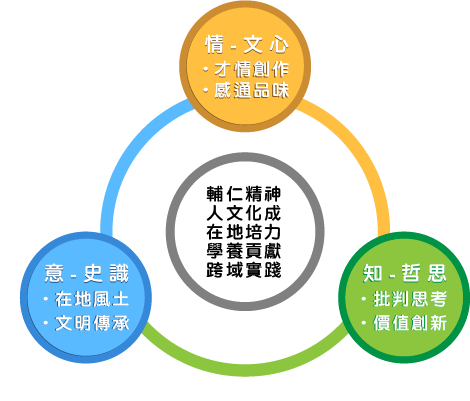
The development of this program is founded upon five core objectives: "Fu Jen Spirit," "Humanistic Cultivation," "Local Empowerment," "Contribution of Knowledge and Learning," and "Cross-disciplinary Practice." Integrating both “knowledge” and “skills” into practical application constitutes the distinctive feature of this program. Its content is divided into two dimensions:
Knowledge Dimension: History and Culture, Philosophy and Religion, Native Language and Literature.
Skills Dimension: Reading Comprehension, Active Listening, Written Expression, Oral Communication, Critical Thinking, Self-directed Learning, Interpersonal Awareness, Collaboration, Service Orientation, Complex Problem Solving, Judgment and Decision-making, Systems Analysis, Systems Evaluation, Creativity, Originality, Flexibility and Adaptability, Initiative, Practical Competence.
Regardless of our background or identity, whenever people live and interact together, they become part of a community. Human activities take place within various communities, including residential neighborhoods, workplace departments, and even spiritual, religious, or interest-based groups that transcend geographical boundaries. Communities vary in size and character, and those who live within them cannot remain detached observers, nor can they completely avoid being influenced by them.
As a union between people and the land they inhabit, a community protects individuals from facing the challenges of nature alone. At the same time, it represents the collective will of its members and provides the support necessary for individual growth and development. A community can be viewed as an extension of the family and a microcosm of society.
In short: A community provides protection and opportunities for personal fulfillment from a humanistic perspective, serving as a fundamental social space beyond purely economic considerations.
According to the German sociologist Ferdinand Tönnies, a community is a form of social organization based on close personal relationships, in contrast to modern society, which is governed primarily by formal rules and institutions. Communities are built upon kinship, neighborhood ties, and friendships. They are social units formed through shared values, culture, and a common living environment.
As civilization evolves, the concept of community has gradually expanded to include both place-based and people-based relationships. Place-based communities increasingly emphasize the connection between people and the land. While land nurtures us, it also requires our care and stewardship. Although communities often begin with shared values and cultural traditions, without continuous development and innovation these common foundations may weaken, become fragmented, or even disappear. As a result, community members may become strangers to one another, diminishing the community's vitality and function.
Community innovation encourages individuals and families to rethink who they are while deepening their understanding of themselves and their local environment. Through innovation, members learn to transcend individual interests and work toward the common good. This strengthens social bonds, preserves cultural values, and promotes collective well-being.
In short: The purpose of community innovation is to preserve community identity, rediscover local characteristics, and create new traditions for the future.
Just as every person possesses a unique personality, every community has its own distinctive character. Communities, formed by people beyond family ties, have countless possibilities for growth and development. Their unique identities are shaped by natural environments, ecosystems, history, and economic activities. Long-term residents often develop a deep emotional connection to the land, giving rise to local traditions, lifestyles, and cultural practices.
From a practical perspective, community development is closely linked to economic development. Communities contain generations of wisdom, cultural heritage, and historical experiences, making them ideal foundations for cultural and creative industries. However, unlike conventional cultural industries, community innovation places humanistic values at its core. Economic development is important, but it is guided by a broader commitment to cultural enrichment and social well-being.
In short: Community innovation is a human-centered creative endeavor rooted in people's lived experiences and emotional connections to their local environment.
A community is an organic and autonomous group united by shared culture and collective experience. Maintaining a healthy community requires attention to both its physical and spiritual dimensions. The physical health of a community is reflected in its cohesion, identity, and members' concern for one another. The spiritual health of a community lies in its vitality, creativity, and ability to adapt and thrive in changing times.
Because every individual represents the smallest unit of a community, caring for the community is also a form of self-realization. Much like the relationship between parents and children, love creates limitless possibilities for growth and innovation. Through active engagement and mutual support, communities continue to evolve while preserving their core values.
In short: Community innovation is driven by love. Through understanding, acceptance, development, and action, the community becomes an expanded version of ourselves that continues to grow with the times.

